
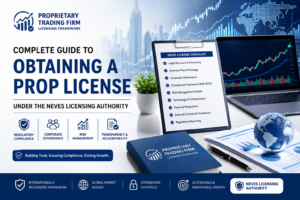
The proprietary trading industry continues to evolve as financial markets become more sophisticated and technology-driven. Firms seeking to establish a professional proprietary trading business must demonstrate sound governance, effective risk management, and strong regulatory compliance before beginning operations. Obtaining a prop license is an important step toward building a credible and sustainable trading firm.
This guide explains the process of obtaining a prop license under the Neves Licensing Authority, including the key requirements, application process, governance expectations, and ongoing compliance obligations associated with the Proprietary Trading Firm Licensing Framework.
What Is a prop license?
A prop license authorizes a firm to operate as a proprietary trading business under an established regulatory framework. Unlike traditional brokerage firms, proprietary trading firms trade using the company’s own capital rather than managing client investments.
The Neves Licensing Authority has developed the Proprietary Trading Firm Licensing Framework to encourage responsible market participation while promoting transparency, operational resilience, and sound corporate governance.
A properly licensed proprietary trading firm demonstrates its commitment to maintaining professional standards and regulatory compliance throughout its operations.
Why a prop license Matters
Operating under a recognized licensing framework offers significant advantages for proprietary trading firms.
Some of the key benefits include:
- Increased business credibility
- Stronger corporate governance
- Improved operational transparency
- Better risk management practices
- Enhanced confidence among investors and business partners
- A structured regulatory framework for long-term growth
A PROP License also demonstrates that a trading firm has implemented policies designed to support responsible trading activities.
Key Requirements for Obtaining a prop license
Before submitting an application, firms should ensure they satisfy the fundamental requirements established under the Neves Licensing Authority.
1. Establish a Legal Business Entity
Applicants should first establish a properly registered legal entity with a transparent ownership structure.
The licensing authority generally reviews:
- Shareholders
- Beneficial owners
- Directors
- Senior management
- Corporate organizational structure
Transparency throughout the organization helps strengthen regulatory confidence.
2. Prepare a Comprehensive Business Plan
A detailed business plan is one of the most important components of the application.
The plan should clearly explain:
- Trading strategies
- Target financial markets
- Operational model
- Technology infrastructure
- Revenue model
- Financial projections
- Growth objectives
- Risk management procedures
A well-prepared business plan demonstrates that the firm has carefully planned its operations before entering regulated markets.
3. Build Strong Corporate Governance
Corporate governance plays a central role within the Proprietary Trading Firm Licensing Framework.
Applicants should establish:
- Clearly defined board responsibilities
- Management oversight
- Internal reporting procedures
- Decision-making processes
- Accountability structures
Effective governance helps ensure responsible management of trading activities.
4. Develop a Compliance Framework
Every licensed proprietary trading firm should implement comprehensive compliance procedures before beginning operations.
These typically include:
- Anti-Money Laundering (AML) policies
- Know Your Customer (KYC) procedures where applicable
- Internal compliance monitoring
- Record-keeping policies
- Operational controls
- Regulatory reporting procedures
A strong compliance framework supports ongoing regulatory obligations.
Risk Management Expectations
Risk management is one of the most critical aspects of proprietary trading.
Applicants should establish policies covering:
- Market risk
- Liquidity risk
- Operational risk
- Technology risk
- Cybersecurity
- Business continuity planning
- Capital management
- Internal trading controls
Documented risk management procedures demonstrate that the firm is prepared to manage market volatility responsibly.
Documentation Required
Preparing complete documentation before submitting an application can significantly improve the licensing process.
Typical documentation may include:
- Certificate of incorporation
- Corporate organizational chart
- Shareholder information
- Beneficial ownership details
- Business plan
- Financial forecasts
- Governance policies
- AML and compliance manuals
- Risk management framework
- Internal control procedures
- Director and senior management information
Well-organized documentation allows regulators to conduct a more efficient review.
The PROP License Application Process
Although each application is assessed individually, the licensing process generally follows several important stages.
Initial Planning
The applicant defines its trading model, governance structure, compliance framework, and operational objectives.
Application Preparation
All required documentation, policies, financial projections, and internal procedures are compiled into the formal application.
Regulatory Assessment
The Neves Licensing Authority reviews the application to determine whether the firm satisfies the standards established under the Proprietary Trading Firm Licensing Framework.
During this stage, regulators may request additional information or clarification where necessary.
Licensing Decision
After completing the review process, the authority determines whether the applicant has demonstrated sufficient readiness to operate as a licensed proprietary trading firm.
Ongoing Compliance After Licensing
Receiving a PROP License is only the beginning of regulatory compliance.
Licensed firms should continue to maintain:
- Regular internal audits
- Compliance monitoring
- Governance reviews
- Risk assessments
- Staff training
- Policy updates
- Accurate record keeping
- Internal reporting procedures
Continuous compliance supports operational stability and responsible trading practices.
Common Challenges Applicants Face
Many proprietary trading firms encounter delays because they underestimate the preparation required.
Common issues include:
- Incomplete documentation
- Weak governance frameworks
- Limited compliance procedures
- Inadequate risk management policies
- Unclear ownership structures
- Unrealistic financial projections
Addressing these issues before applying can help streamline the licensing process.
Why Professional Preparation Matters
Preparing a PROP License application requires expertise across legal, financial, governance, and compliance disciplines. Many firms work with experienced registered agents or regulatory advisors to ensure that application materials are accurate, complete, and aligned with licensing expectations.
Professional preparation can reduce delays and improve the quality of the overall submission.
Conclusion
Obtaining a prop license under the Neves Licensing Authority requires more than completing an application. Firms must establish transparent governance, implement effective compliance programs, develop comprehensive risk management frameworks, and prepare accurate supporting documentation.
By understanding the Proprietary Trading Firm Licensing Framework and investing in thorough preparation, proprietary trading firms can build a strong foundation for sustainable growth while operating within a structured and internationally recognized regulatory environment.
